























Current Questions and Exciting Answers About Collagen
What exactly is collagen and where does it occur in the body?
Collagen is one of the most common proteins in the human body and accounts for about 30% of the total protein mass. It is a structural protein. Everything in the body with a defined structure consists mainly of collagen: connective tissue, skin, bones, nails, tendons, cartilage, ligaments. Collagen provides strength, elasticity and structure.
How can you recognise the importance of collagen?
A typical example is dark circles under the eyes. With age, they become more pronounced in some people and less so in others. The cause is usually the breakdown of collagen in the tissue – this is where its role is particularly evident.
Collagen is currently on everyone's lips: is this reasonable?
Scientists do not yet unanimously agree, but the current collagen boom is certainly justified. For a long time, it was believed that the intake of essential amino acids was particularly important. Collagen does not provide many of these and contains very little leucine in particular. This is why collagen was underestimated for so long. However, there has been a shift in thinking: collagen is becoming increasingly accepted in the scientific community.
What role does collagen play in sport?
Collagen is essential for the stability of tendons, ligaments and joints. It supports the body in healing after injuries or operations and plays an important role in regeneration after intensive, eccentric stress that strains the tissue. The body's own collagen production already decreases from the mid-20s onwards – which is why collagen is not only of interest to senior athletes.
In which sports is collagen particularly recommended?
In sports such as running, trail running or team sports such as football or handball, where high stresses are placed on tendons and joints.
Where does collagen occur naturally in the diet?
A classic example is goulash, which is prepared from ragout and braised for a long time. Such cuts of meat contain plenty of collagen. Unfortunately, however, cuts of meat and dishes rich in connective tissue are no longer popular in the modern diet or have almost disappeared.
Can whey protein be replaced with collagen in the diet?
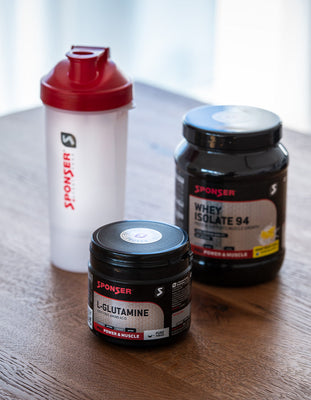
No, definitely not. Whey protein provides a mixture of high-quality amino acids and is particularly rich in leucine. About 50% consists of branched-chain amino acids (BCAAs), which our body cannot produce itself and which must be obtained through food. Leucine is the key trigger for muscle protein synthesis – i.e. for muscle building and regeneration. Collagen, on the other hand, mainly contains glycine, proline and hydroxyproline. These three amino acids are the main building blocks of the collagen structure, which gives tissue its strength and elasticity. They are missing in whey protein nearly entirely. That is why combining collagen with an essential‑amino‑acid‑rich protein such as whey can in certain situations be beneficial.
Why is vitamin C important for collagen absorption?
The body needs this vitamin to be able to utilise collagen properly. Combining collagen with orange juice, fresh fruit or berries – for example in muesli – supports its metabolism and collagen synthesis in the body.
Are there qualitative differences in collagen from food?
Yes. Pure collagen, as found in gelatine (e.g. when cooking panna cotta or cakes), is first broken down during the digestive process before it can be absorbed. Collagen hydrolysates, on the other hand, are already enzymatically broken down and can therefore be utilised more easily and quickly. For this reason, dietary supplements are usually based on collagen hydrolysates. These consist of short amino acid chains of the collagen protein, known as peptides, which have a relatively low molecular weight – around 2000 Daltons (Da). A lower molecular weight permits easy digestion and fast absorption.
Are there any differences between elite athletes and recreational athletes when it comes to collagen intake?
No, the recommendation is the same for both: approximately 15 g of collagen per day. It is best to take it on an empty stomach together with vitamin C, as this prevents other digestive processes from impairing absorption. In practice, however, this recommendation is difficult to implement and not very realistic.
What about during a rehabilitation phase? Should higher doses of collagen be taken?
There are currently no studies that define a specific amount of collagen for injuries. Therefore, the usual dosage recommendations apply. It is best to start collagen supplementation immediately after a joint or ligament injury to support the regeneration of the supporting structures as soon as mobilisation and initial movements are permitted again.
SPONSER has two collagen products in its range. How do they differ?
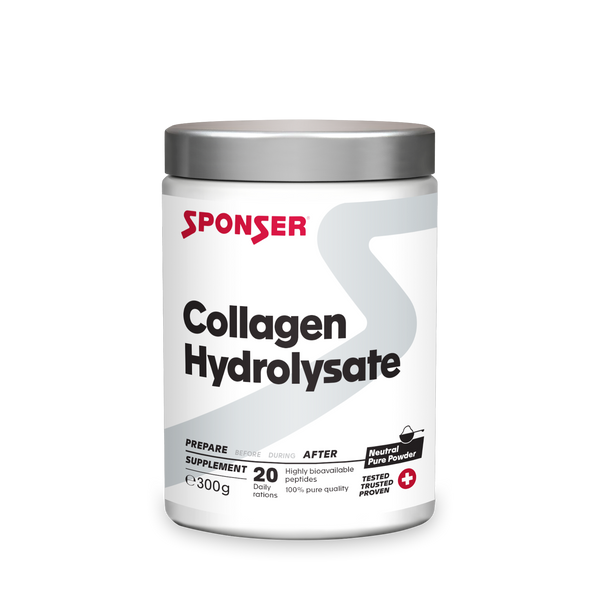
Collagen Hydrolysate Neutral is tasteless and contains no additives. It can be used variously, for example in coffee, protein shakes or together with orange juice and fruit.
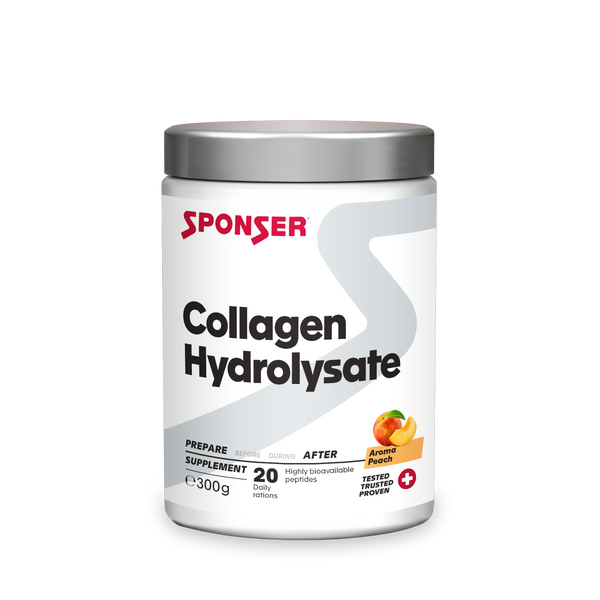
Collagen Hydrolysate Peach already contains vitamin C. It is prepared with water and makes a refreshing drink that supports collagen absorption.